Smartwatches give you quick access to notifications, health data, and payments without pulling out your phone, and budget models now cover most must-have features.
You can shop smarter online worldwide by knowing where the real deals live, which specs matter, and which models routinely drop below retail.
Best Places to Buy Cheap Smartwatches Online
Prices jump daily, so timing and the right storefronts make the difference; therefore, use the sources below to lock in reliable discounts and protections.
Online Marketplaces
Large marketplaces often run coupon events and bundle promos, which means you can stack seller discounts with platform codes for double savings.
Look for official brand storefronts within marketplaces to reduce the risk of gray imports and missing warranties.
Official Brand Stores
Brand sites run seasonal clearance on prior-year models and certified-refurbished units, in turn giving you warranty coverage at lower prices. Sign up for emails or app notifications to stay informed about limited-time flash sales.
Certified Refurbished Outlets
Manufacturer-backed refurbishers and authorized partners test batteries, replace wear items, and add fresh warranties, as a result giving you near-new devices for less. Prioritize listings that state battery health minimums and return windows.
Electronics Retailers and Carriers
Retailers and mobile carriers frequently bundle watches with phones or plans, which means you can offset cost with trade-ins, gift cards, or bill credits. Check open-box sections online for returns that include a full warranty.
Deal Aggregators and Community Forums
Community deal posts surface regional coupon codes and price histories, that way you can verify if a “sale” actually beats historical lows. Filter results by “worldwide shipping” or your region to avoid surprise import fees.
Local Classifieds and Resellers
Private resales can be cheap; consequently, you must validate serial numbers, confirm activation lock status, and insist on in-person or escrow transactions with receipts.
Price Tiers: Plain vs. Pricey
Feature needs vary, and overspending benefits no one; which means you should map must-haves to the right tier before browsing links.
| Tier | Typical street price | Core strengths | Common trade-offs |
| Basic/Budget | US$99–US$250 | Notifications, heart-rate tracking, step counts, GPS on many models, app support on major platforms | Fewer third-party apps, simpler materials, shorter warranties from some sellers |
| Midrange | US$250–US$400 | Brighter displays, faster chips, better sensors, optional LTE, voice assistants | One to two days of battery on many full-feature models |
| Fitness-first | US$150–US$300 | Strong GPS accuracy, training tools, long battery life, rugged designs | Limited smartwatch apps, basic media features |
| Golf/sport specialty | US$150–US$300 | Sport-specific data, course maps or coaching, durable build | Minimal non-sport apps, limited music or payments |
Budget Picks to Watch
Choice overload can slow down decisions, so a shortlist helps you narrow down options quickly. Use the examples below as price and feature benchmarks when comparing listings.
Popular budget options frequently discounted online:
| Model (examples) | Works with | Why it’s compelling | Typical caveats | Usual sale range* |
| Amazfit Active 2 | Android, iOS | Bright AMOLED, long battery life, 160+ sport profiles, onboard GPS, offline maps | Basic app ecosystem, voice assistant is limited | ~US$90–US$120 |
| Amazfit Bip 6 | Android, iOS | Very low price, 14-day battery, big AMOLED display, 5-ATM rating | Limited apps, sleep accuracy varies | ~US$60–US$90 |
| Apple Watch SE (2022) | iOS only | Large app library, fall detection, Family Setup, optional LTE | No always-on display, ~one day battery | ~US$150–US$249 |
| Samsung Galaxy Watch FE | Android only | Flagship-style health features, sapphire glass, optional LTE | Smaller display, features best on Samsung phones | ~US$170–US$220 |
| Samsung Galaxy Watch 7 | Android only | Accurate sleep insights, AI wellness tools, responsive UI | Around one day battery for most users | ~US$249–US$299 |
| Google Pixel Watch 2 | Android only | Excellent heart-rate accuracy, Fitbit integration, safety features | One size, ~24-hour battery | ~US$229–US$299 |
| Garmin Forerunner 55 | Android, iOS | Reliable GPS, training suggestions, multi-week battery in smartwatch mode | Minimal apps, no NFC or music storage | ~US$140–US$199 |
| Garmin Approach S12 | Android, iOS | Golf course database, shot distance, long battery life | No heart-rate sensor, basic smartwatch features | ~US$149–US$199 |
*Sale ranges fluctuate by region and retailer; expect deeper cuts during global shopping events.
What to Check Before You Buy
Specs pages can be noisy, which means you should focus on signals that affect daily use rather than marketing labels.
- Compatibility and OS: First, match your phone; Apple Watch pairs best with iPhone. Wear OS and Galaxy models require Android, while Garmin and Amazfit work reliably with both platforms.
- Battery life: Daily-charge watches suit app-heavy users, while fitness-first models often last a week or more, which helps if you track multi-day activities.
- Comfort and sizing: Case diameter, thickness, and weight influence sensor accuracy and wearability during sleep, which in turn affects health metrics.
- Water resistance: Look for 5-ATM or higher if you swim regularly, and verify swim tracking modes if pool data is important to you.
- Sensors and accuracy: Prioritize proven GPS performance and consistent heart-rate readings over headline features like EKG, which you won’t use frequently.
- Charging method: Magnetic pucks or wireless pads simplify travel charging, hence replacement cables are easier to source worldwide.
- Apps and payments: Confirm availability of your must-have apps and mobile payments in your country or region to avoid post-purchase frustration.
- LTE option: Standalone connectivity is useful for runs or calls without a phone, but monthly plan fees add up; thus, consider Wi-Fi models if budgets are tight.
Deal Tactics That Save Real Money
Retail pages push urgency, so you need a repeatable process; as a result, apply the checklist below every time you shop.
- Track price history using deal sites or browser extensions to determine the actual floor price for the specific SKU.
- Target prior-year models during new launches, since retailers clear inventory when the latest versions arrive.
- Hunt certified-refurbished units with at least a one-year warranty and free returns to strike a balance between savings and safety.
- Stack coupons, store credits, student or educator discounts, and payment-method cash back to reach the best-in-cart totals.
- Compare global and local listings, and factor in shipping, VAT, and import fees to the doorstep to avoid fake savings.
- Check open-box listings at reputable retailers for nearly new units that include all accessories.
- Validate return windows and restocking fees, and screenshot the listing in case specs or bonuses change after purchase.
How to Read Tests and Reviews Like a Pro
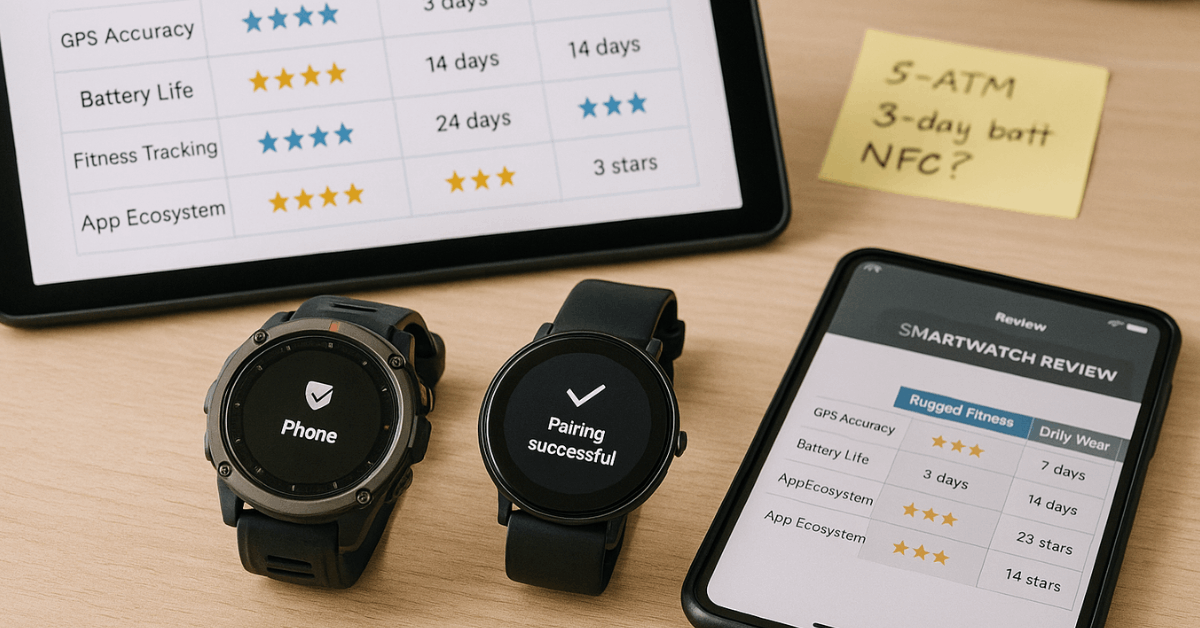
Marketing claims often omit context, which means you should rely on consistent testing signals rather than anecdotes alone.
- Look for repeatable GPS routes compared against dedicated sports watches, not just single-run maps.
- Check heart-rate charts during intervals and steady efforts, since stable traces matter more than peak values.
- Confirm sleep tracking against rings or chest straps if sleep data guides your training or recovery choices.
- Read app ecosystem notes for your region, because available Tiles, complications, and payment support differ worldwide.
- Note battery tests that mirror your habits, such as always-on display enabled, LTE off, and two GPS workouts per week.
- Prioritize long-term reviews that mention software updates, which can improve accuracy or add features months after launch.
Quick Buying Steps
Decisions stall when steps feel fuzzy, so run this short sequence to finish confidently, thus avoiding endless tab hopping.
- Match platform: choose Apple Watch for iPhone users or Android-friendly models for Android users; consider Garmin or Amazfit if cross-platform compatibility is a priority.
- Pick a tier: choose Basic for notifications and daily fitness, Fitness-first for training tools, or Midrange for richer apps and voice assistants.
- Shortlist two models: use the table above to identify one feature-rich option and one battery-focused option.
- Price-check across three sources: compare a marketplace official store, a brand refurb page, and a major electronics retailer.
- Verify fine print: confirm warranty region, return policy, water rating, band size, and charger type.
- Buy at the floor: pull the trigger when a tracked price hits a historical low or a bundle adds real value you will actually use.
Conclusion
You get the best results when you match the watch to your phone, buy at verified low prices, and prioritize the features you will use daily.
Apply the checklist, compare a couple of strong candidates, and secure the deal where warranty and returns are clear worldwide.